
Dog Behaviorist
Service in San Diego
Get professional help from a dog training and behavior company with more than 40+ years of experience
Is Your Fur Baby Acting Out or Acting Up?
Natural canine behaviors, such as chewing, digging, biting, scratching, running away, and barking can be challenging for dog owners to manage and can be helped with dog behaviorist training.
With Fon’s Dog Training, your fur baby is in the most capable of hands. From correcting ‘bad behaviors’ to strengthening the bond between pet parent and pet, we can help you and your dog through virtually any challenge.
What is a Dog Behaviorist?
A dog behaviorist is a professional trained and experienced in interpreting and understanding WHY a dog may exhibit certain behaviors. Dog behaviorists, such as those from Fon’s Dog Training, seek to discover and understand the motives (good or bad) that drive such behavior.
In other words, dog behaviorists treat the action (barking, biting, chewing, etc.) as a symptom of an underlying motivation or cause. This enables behaviorists to effectively address the reason behind the behavior, getting to the root and origin of the problem.
By understanding a dog’s reasoning behind its action, trainers, and owners will be better equipped to help their dog work through the issues in the most effective way possible.
Dog behaviorists work with pets and their owners to evaluate, observe and interpret dogs’ behavior in various settings, ranging from the home to dog parks, with people or when introduced to other dogs, and more.

The Role of a Dog Behaviorist
Dog behaviorists take on both an observatory and hands-on role with dogs. The role requires years of experience, and a natural intuition with regard to pets, people, and the environment.
Dog behaviorists aren’t always trying to alter the pet’s behavior, such as to encourage or discourage a particular action (i.e. tail wagging), but rather seeking to help pet owners understand how to interpret their dog’s communication.
Dog Behavior is evaluated based on environmental factors, including but not limited to:
Other aspects a dog behaviorist is responsible for taking into consideration include the dog’s age, breed, health, history of neglect or trauma, and the pet’s unique personality type.
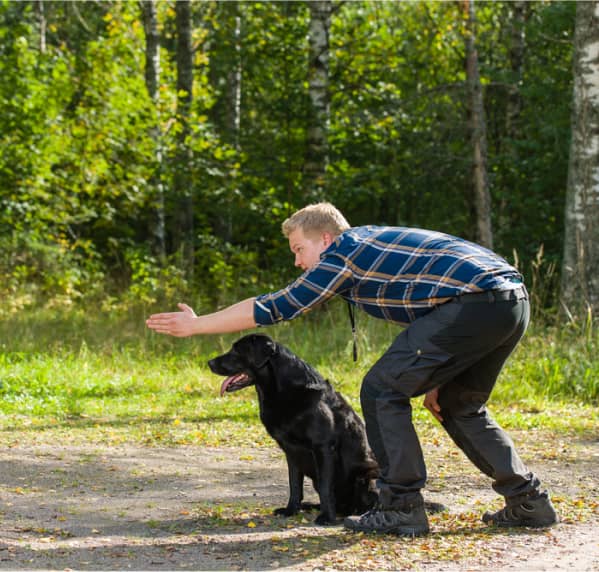
Dog Behaviorist vs Dog Trainer Overview
Now that you have a better understanding of what a dog behaviorist does, let’s take a closer look at dog trainers.
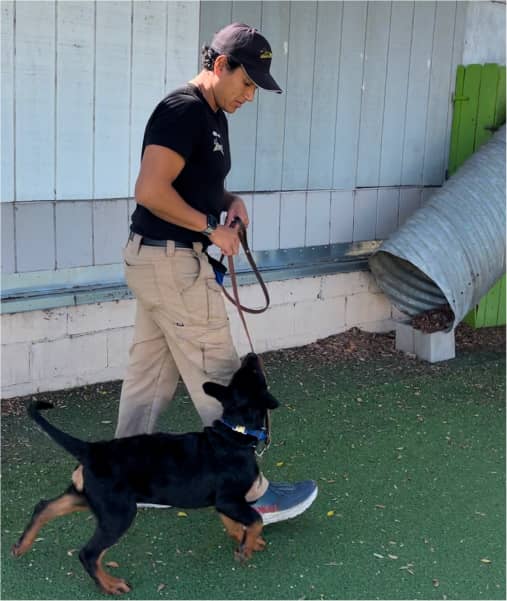
Dog trainers typically work hands-on with the dog and its owner(s) both separately and together. The goal of a dog trainer is typically to correct ‘bad’ behaviors and/or teach dogs certain desirable actions or traits. Dog trainers will often teach ‘tricks’ such as handshaking, rolling over, etc., as well as commands such as ‘sit’, ‘stay’, ‘come’, and more.
Examples of Training Techniques Employed by Dog Trainers
Other aspects a dog behaviorist is responsible for taking into consideration include the dog’s age, breed, health, history of neglect or trauma, and the pet’s unique personality type.
Other aspects a dog behaviorist is responsible for taking into consideration include the dog’s age, breed, health, history of neglect or trauma, and the pet’s unique personality type.
The role requires years of experience, and a natural intuition with regard to pets, people, and the environment. Dog behaviorists aren’t always trying to alter the pet’s behavior, such as to encourage or discourage a particular action (i.e. tail wagging), but rather seeking to help pet owners understand how to interpret their dog’s communication.
Licensing Requirements
Dog Training Licensure
In the United States, dog trainers are not required to have any type of licensing in order to market themselves as a trainer and to carry out services. However, some trainers may opt to undergo training and education that may result in certifications.
Dog Behaviorist Licensure
Similar to trainers, no specific licensures or certifications are required to become a dog behaviorist. However, dog behaviorists often have significant experience (years to decades) and/or education that better prepares them to fulfill their role.
For example, Fon’s Dog Training’s training director has more than 40 years of experience, with a long and documented track record of achieving results for pet owners.
DIFFERENCES AND SIMILARITIES:
Dog Trainer vs Dog Behaviorist
Let’s recap the major similarities and differences between these two roles.
Our Testimonials
Visit Our Dogs


Our San Diego Location
Send us a message
Directions to Fon’s Canines Dog Training from Common Places in San Diego
San Diego International Airport to Fon’s Canines Dog Training – San Diego Dog Training
3225 N Harbor Dr, San Diego, CA 92101
Get on I-5 N from N Harbor Dr and India St
9 min (3.4 mi)
Follow I-5 N to Garnet Ave. Take exit 23B from I-5 N
5 min (5.2 mi)
Drive to Santa Fe St
3 min (1.1 mi)
Destination:
5050 Santa Fe St Suite B, San Diego, CA 92109
Downtown San Diego to Fon’s Canines Dog Training – San Diego Dog Training
Get on I-5 N
3 min (0.8 mi)
Follow I-5 N to Garnet Ave. Take exit 23B from I-5 N
6 min (6.7 mi)
Drive to Santa Fe St
3 min (1.1 mi)
Destination:
5050 Santa Fe St Suite B, San Diego, CA 92109
La Jolla to Fon’s Canines Dog Training – San Diego Dog Training
Take Fay Ave and Girard Ave to Torrey Pines Rd – 3 min (0.7 mi)
Continue on Torrey Pines Rd. Take La Jolla Pkwy and I-5 S to Damon Ave – 8 min (5.1 mi)
Follow Damon Ave and Santa Fe St to your destination – 2 min (0.5 mi)
Destination:
5050 Santa Fe St Suite B, San Diego, CA 92109
Send us a message